Question 13
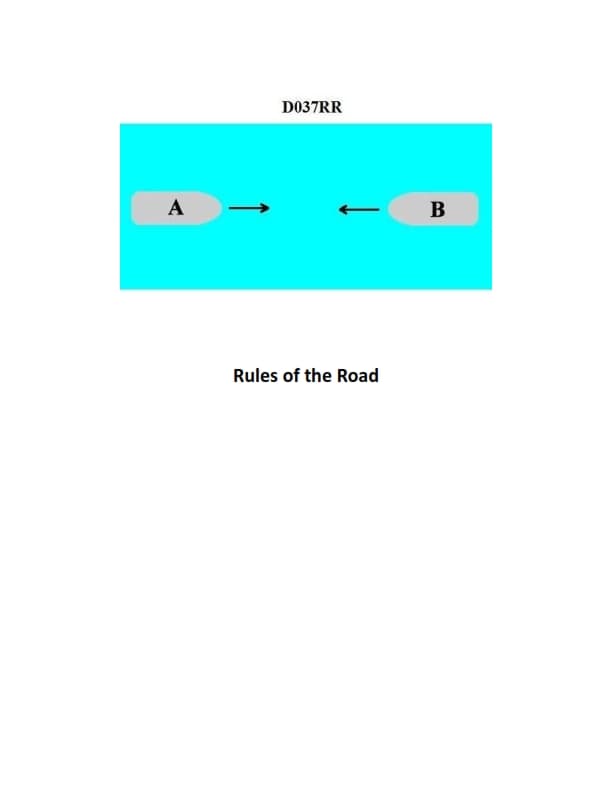
RVR02INLAND ONLY Two power-driven vessels are meeting in a narrow channel on the Great Lakes as shown in illustration D037RR below. Vessel "A" is downbound with a following current. Vessel "A" shall do which of the following?
AI Explanation
The Correct Answer is D
**Explanation for Option D ("All of the above"):**
The scenario described—two power-driven vessels meeting in a narrow channel on the Great Lakes, where Vessel "A" is downbound with a following current—is governed by the Inland Rules of the Road (specifically the Great Lakes Pilotage Rules, which fall under the Inland Rules).
1. **Propose the manner of passage (Option A):** Inland Rule 9(a)(ii) states that in a narrow channel, a vessel descending a river or taking advantage of a favorable current shall **propose the manner of passage** and initiate the maneuvering signals. Therefore, Vessel A must propose the passage.
2. **Initiate the maneuvering signals (Option B):** As noted above, Rule 9(a)(ii) mandates that the vessel proposing the manner of passage (Vessel A) also **initiate the maneuvering signals**.
3. **Have the right of way (Option C):** While the term "right of way" is generally avoided in favor of "stand-on vessel" or "privilege," Inland Rule 9(a)(ii) grants the vessel navigating with the current (Vessel A) the *privilege* over the vessel navigating against the current (the upbound vessel). This privilege effectively means Vessel A has the priority in determining the meeting arrangement and passage. This is the common understanding and application of Rule 9(a)(ii)—the downbound vessel with a following current is the burdened vessel (the one that proposes the maneuver) but is granted the prerogative of passage.
Since Vessel A must propose the passage, initiate the signals, and is granted the privilege/priority of passage under Rule 9(a)(ii), all three components are correct.
**Explanation of Incorrect Options:**
* **A) Propose the manner of passage:** While correct, this option is incomplete because Vessel A must also initiate the signals and has the governing priority of passage.
* **B) Initiate the maneuvering signals:** While correct, this option is incomplete as it ignores the requirement to propose the manner of passage and the resulting priority of the vessel navigating with the current.
* **C) Have the right of way:** While Vessel A is granted the priority/privilege of passage under the narrow channel rule (Rule 9(a)(ii)), this option is incomplete as it misses the mandatory actions of proposing the passage and initiating signals.