Question 2
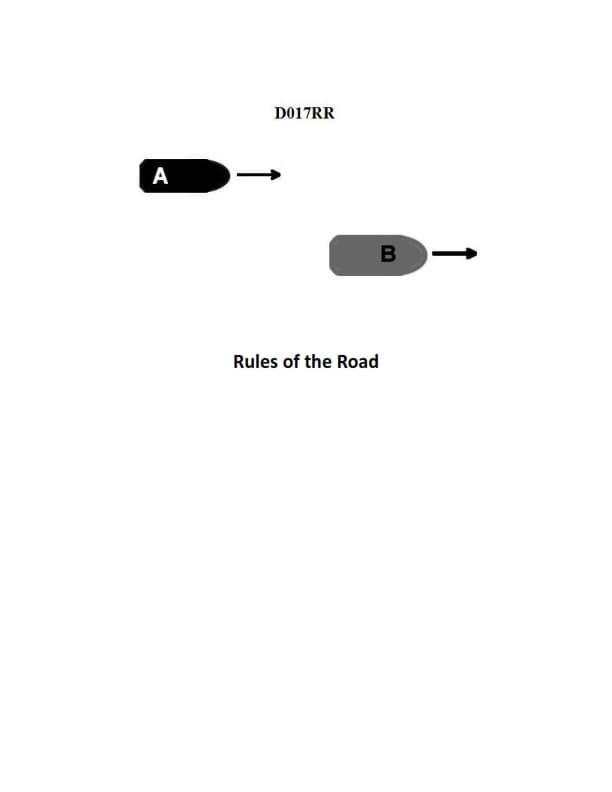
RVR02BOTH INTERNATIONAL & INLAND Vessel "A" is overtaking vessel "B" as shown in illustration D017RR below and will pass without changing course. Which light will vessel "A" observe on vessel "B"?
AI Explanation
The Correct Answer is C.
### Explanation for Option C (white stern light)
**Option C ("white stern light") is correct because Vessel A is overtaking Vessel B.**
1. **Definition of Overtaking:** A vessel is defined as overtaking if it approaches another vessel from a direction more than $22.5^\circ$ abaft (behind) the beam of the vessel being overtaken. In this scenario, Vessel A is overtaking Vessel B, meaning Vessel A is situated almost directly behind Vessel B.
2. **Required Lights for Overtaking:** The vessel being overtaken (Vessel B) must display a **white stern light** (or masthead lights and sidelights, if observed from the front/side). The stern light is a white light placed as nearly as practicable at the stern, shining over an arc of the horizon of $135^\circ$ ($67.5^\circ$ on each side of the vessel).
3. **Observation by Overtaking Vessel:** Since Vessel A is approaching from the stern (behind) of Vessel B, the only navigation light Vessel A will see displayed by Vessel B is the $135^\circ$ arc of the **white stern light**.
### Explanation of Incorrect Options
**A) green sidelight:**
The green sidelight is displayed on the starboard (right) side and covers an arc of $112.5^\circ$ forward. Because Vessel A is overtaking Vessel B (approaching from the stern), the position of Vessel A is well outside the arc covered by Vessel B's green sidelight.
**B) yellow towing light:**
The yellow towing light is required only if Vessel B is engaged in towing operations, and it is displayed above the stern light. Unless specified that Vessel B is towing, its presence cannot be assumed. Even if it were present, the primary and required light visible from the stern is the white stern light.
**D) None of the above:**
This is incorrect because the white stern light is the specific light required by the COLREGs (International Regulations for Preventing Collisions at Sea) to be displayed toward an overtaking vessel.
Related Questions
#1 How is an occluded front represented on a weather map?#1 The following questions (1-10) are based on the Army Corps of Engineers Mississippi River Maps (Cairo to
the Gulf) and the Light List.
AHP = Above Head of Passes
LMR = Lower Mississippi River
UMR = Upper Mississippi River
OHR = Ohio River
ACOE = Army Corps of Engineers
At 0620 on 25 November, you depart Cape Girardeau fleeting area (mile 53.0 UMR) bound for Bisso Towboat
Co. Mooring New Orleans, LA, (mile 102.0 AHP).
Your engines are turning for 8.2 mph. You estimate the current at 1.5 mph. What is your speed over the
ground?