Question 21
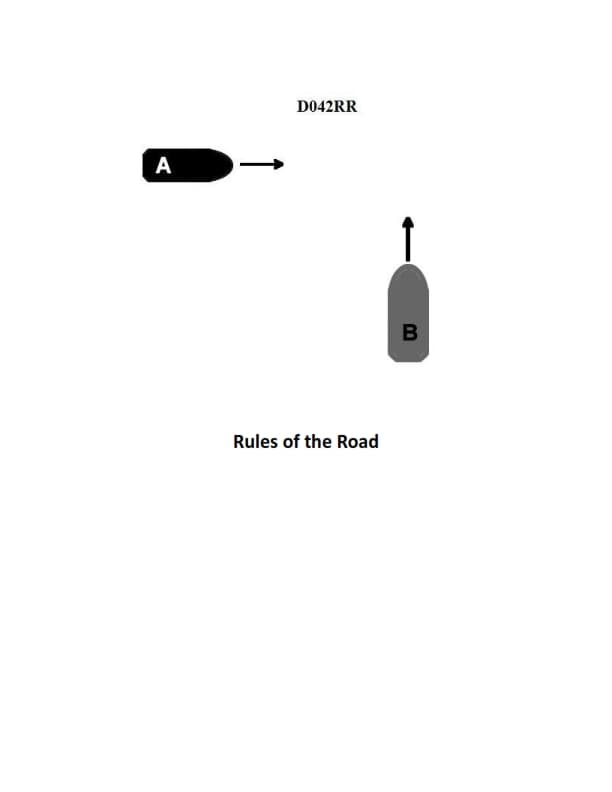
RVR05INLAND ONLY Two power-driven vessels are crossing within a half a mile of each other as shown in illustration D042RR below. Vessel "A" sounds one short blast on the whistle. What should Vessel "B" sound if in agreement?
AI Explanation
The Correct Answer is B.
**Explanation of Option B (one short blast):**
Under the Inland Rules of Navigation, when power-driven vessels are within sight of each other and maneuvering in a crossing, meeting, or overtaking situation, proposals to alter course or adjust passing arrangements must be signaled by short blasts. The Rules require that the responding vessel must signal agreement by sounding the **same blast signal** given by the proposing vessel. Since Vessel A proposed the maneuver with one short blast ("I intend to leave you on my port side"), Vessel B, if in agreement, must sound one short blast to acknowledge and confirm the agreed-upon maneuver.
**Why the other options are incorrect:**
* **A) three short blasts:** This signal means, "I am operating astern propulsion" (backing up). It is not used to signal agreement to a crossing maneuver proposed by another vessel.
* **C) two short blasts:** This signal means, "I intend to leave you on my starboard side." If Vessel B sounded this, it would be proposing a *different* passing arrangement (starboard-to-starboard), which is a signal of disagreement or a counter-proposal, not an agreement.
* **D) two prolonged blasts followed by two short blasts:** This is the signal used under Inland Rules (Great Lakes/Western Rivers rules, specifically) to signal an intent to overtake on the port side, or, more generally, is a signal designated for restricted visibility for a vessel underway but stopped, or for a sailing vessel or vessel engaged in towing in restricted visibility. It is not the standard whistle agreement signal for a crossing proposal under Inland Rules.