Question 13
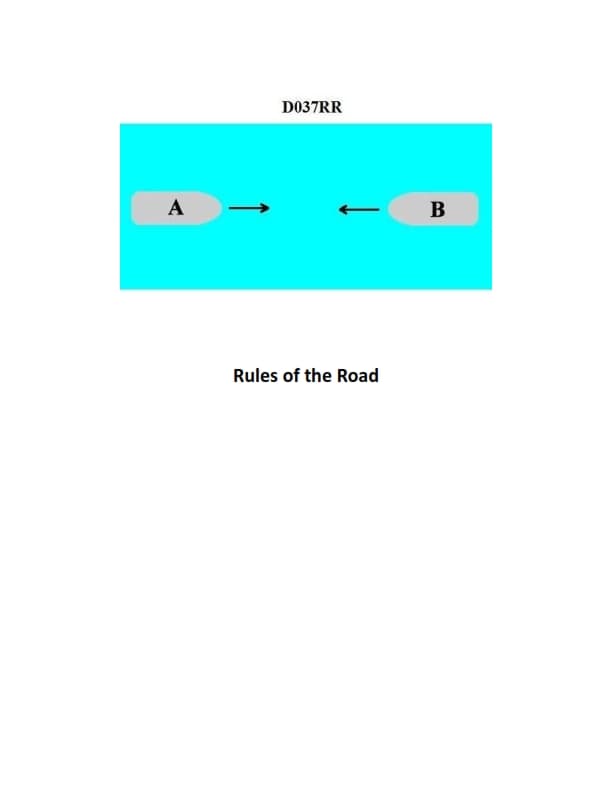
TV03INLAND ONLY Two power-driven vessels are meeting in a narrow channel on the Great Lakes as shown in illustration D037RR below. Vessel "A" is downbound with a following current. Vessel "A" shall do which of the following?
AI Explanation
The Correct Answer is D
**Explanation for Option D (All of the above):**
The scenario describes two power-driven vessels meeting in a narrow channel on the Great Lakes, with Vessel "A" being **downbound** and having a **following current**. This situation is governed by the Inland Rules of the Road (specifically, Rule 9 - Narrow Channels) and the Inland Western Rivers Rules (which include specific provisions for vessels proceeding downbound with a current, applied to the Great Lakes and other non-Western River navigable waters through specific annexes or long-standing practice/interpretation related to navigation on rivers/channels).
1. **Propose the manner of passage (Option A):** Inland Rule 9(a)(ii) states that a vessel proceeding **downbound** with a following current shall have the right-of-way over an upbound vessel, and **shall propose the manner of passage**. This makes option A correct.
2. **Initiate the maneuvering signals (Option B):** Since Vessel A is required to propose the manner of passage, it must initiate the necessary whistle signals (maneuvering signals) to communicate its proposal (e.g., one short blast for port-to-port passage, two short blasts for starboard-to-starboard passage). This makes option B correct.
3. **Have the right of way (Option C):** As established by Inland Rule 9(a)(ii), the vessel proceeding downbound with a following current (Vessel A) **shall have the right-of-way**. This makes option C correct.
Since all three individual statements (A, B, and C) are mandated actions for Vessel A under these specific circumstances, "All of the above" (D) is the correct answer.
**Brief Explanation of Why Other Options are Incorrect (in the context of D being correct):**
* **A) Propose the manner of passage:** While this is a true action Vessel A must take, it is incomplete because Vessel A must also initiate signals and has the right-of-way. It is not the *most* complete correct answer.
* **B) Initiate the maneuvering signals:** While this is a true action Vessel A must take (as part of proposing passage), it is incomplete because Vessel A also proposes the passage and holds the right-of-way.
* **C) Have the right of way:** While this is true regarding Vessel A's status, it is incomplete because Vessel A is also burdened with the duty to propose the manner of passage and initiate the signals.