Question 12
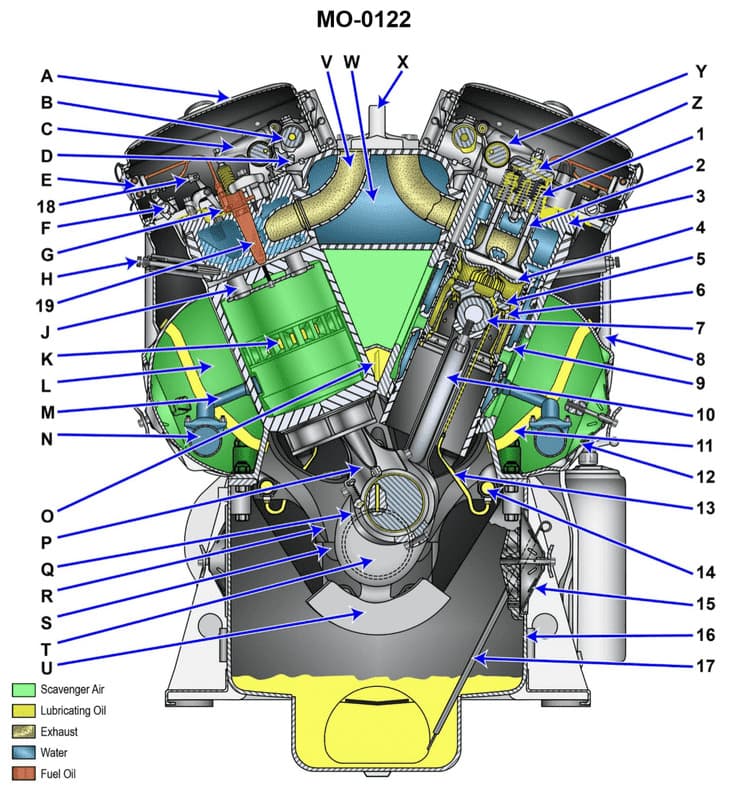
UFIV01The fishing industry line vessel to which you are assigned is fitted with main propulsion diesel engines of the type shown in the illustration. In terms of valve operating gear, cylinder liner type, and connecting rod type, what statement is true? Illustration MO-0122
AI Explanation
The Correct Answer is B
### Explanation of Why Option B is Correct
Option B states: "This is an overhead cam engine, with jacketed cylinder liners and hinged-strap, fork-and-blade connecting rods." This combination accurately describes the design features of many high-speed or medium-speed V-type diesel engines commonly used for main propulsion in fishing vessels (which the referenced illustration, MO-0122, is designed to represent).
1. **Overhead Cam Engine (OHC):** Medium-speed V-configuration engines often utilize an overhead camshaft (or very short cam-to-valve linkage) to improve valve timing and reduce inertia inherent in long pushrod systems, allowing for higher engine RPM.
2. **Jacketed Cylinder Liners:** This term refers to cylinder liners that are supported within a structure where the cooling water circulates around the outer structure (the cylinder block/jacket), making them "dry liners." This is typical for high-output, compact V-engines, as opposed to "wet liners" where the cooling water is in direct contact with the liner exterior.
3. **Hinged-Strap, Fork-and-Blade Connecting Rods:** This is the definitive characteristic of many large V-type engines. This complex assembly allows two connecting rods (one from each bank of the V) to share a single, narrow crankpin journal. The "fork" rod straddles the journal, while the "blade" rod (which often uses a hinged strap to facilitate assembly) fits precisely within the gap of the fork rod. This arrangement ensures proper geometric balance and shared journal loading in V-engines.
### Why Other Options Are Incorrect
**A) This is an overhead cam engine, with wet cylinder liners, and marine-type connecting rods.**
* **Incorrect Feature:** The engine type depicted, utilizing the highly specific fork-and-blade rod design, typically employs dry (jacketed) liners, not wet liners. Furthermore, "marine-type connecting rods" is too vague and does not specify the required fork-and-blade geometry.
**C) This is a pushrod operated overhead valve engine, with jacketed cylinder liners and conventional connecting rods.**
* **Incorrect Feature:** If the engine uses the specialized V-configuration requiring hinged-strap/fork-and-blade rods, it cannot use "conventional connecting rods" (which sit side-by-side or use a master/slave setup, but not the specific fork/blade design necessary to share a narrow journal).
**D) This is a pushrod operated overhead valve engine, with wet cylinder liners and hinged-strap, fork-and- blade connecting rods.**
* **Incorrect Feature:** The use of "wet cylinder liners" is generally incorrect for the type of high-output, medium-speed V-engine that requires the "hinged-strap, fork-and-blade" rod geometry. These designs favor jacketed (dry) liners for structural integrity and thermal management.
Related Questions
#11 You are involved in an emergency landing of a helicopter on the water. You should inflate your life jacket
__________.#11 Referring to the illustration, suppose while in the oil separation processing mode, the oil content detector
display screen shows 17.9 ppm and the oily-water separator is discharging back to the bilge water holding
tank for recirculation. What is most likely the cause? Illustration GS-0175#13 The mollusc dredger to which you are assigned is fitted with generator set drive engines as shown in the
illustration. What statement is true in terms of the combustion chamber design? Illustration MO-0005