Question 10
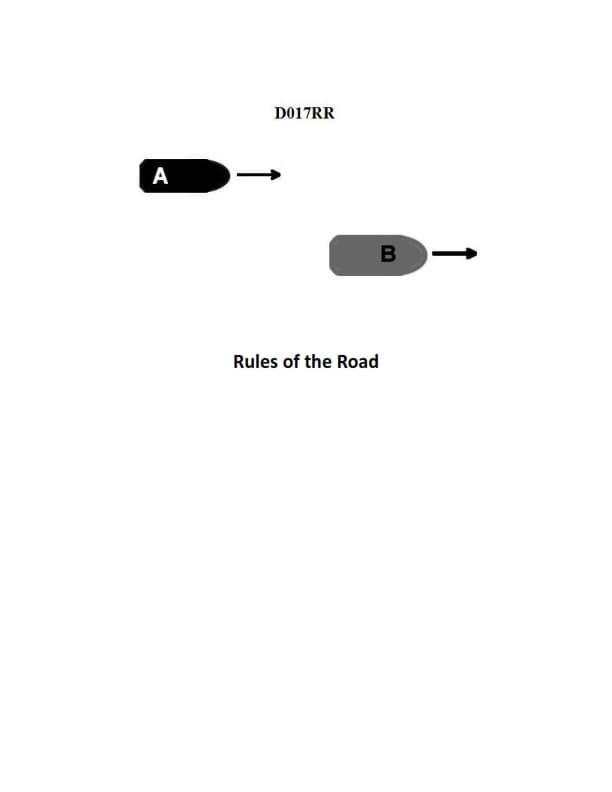
UFV01BOTH INTERNATIONAL & INLAND Vessel "A" is overtaking vessel "B" as shown in illustration D017RR below. Vessel "B" should do which of the following?
AI Explanation
The Correct Answer is B
**Explanation for B (Correct Answer):**
The situation described, where Vessel "A" is overtaking Vessel "B" (as indicated by the context of International/Inland rules regarding passing situations), falls under Rule 13 (Overtaking) of the International Regulations for Preventing Collisions at Sea (COLREGs) and the Inland Rules.
Rule 13(d) states: "Any subsequent alteration of the bearing between the two vessels shall not make the overtaking vessel a crossing vessel within the meaning of these Rules or relieve her of the duty of keeping clear until she is finally past and clear."
Critically, Rule 17 (Action by Stand-on Vessel) applies here. In an overtaking situation, the vessel being overtaken (Vessel "B") is the **stand-on vessel** and has the duty to **hold her course and speed**. The overtaking vessel (Vessel "A") is the give-way vessel and must keep clear.
**Explanation of Incorrect Options:**
* **A) should slow down until vessel "A" has passed:** This is incorrect. The stand-on vessel (Vessel B) must maintain her speed to allow the give-way vessel (Vessel A) to predict her movements accurately and complete the maneuver safely. Slowing down unexpectedly would violate Rule 17(a)(i).
* **C) may steer various courses and vessel "A" must keep clear:** This is incorrect. The stand-on vessel must maintain a steady course (Rule 17(a)(i)). Steering "various courses" would be highly unpredictable, confusing the give-way vessel (A), and creating an immediate risk of collision.
* **D) should change course to the right:** This is incorrect. Changing course is an action reserved for the give-way vessel (A) to keep clear. Vessel B must maintain her current course (Rule 17(a)(i)). Changing course unexpectedly to the right would violate her duty as the stand-on vessel. (Note: Vessel B may take action if collision cannot be avoided solely by the action of the give-way vessel, but the primary duty is to stand on.)
Related Questions
#9 On 21 November at 2100 zone time, you depart LAT 32°12.0'N, LONG 69°26.0'W enroute to LAT 12°05.0'N,
LONG 7°32.0'W. The distance is 3,519 miles, and the average speed will be 12.5 knots. What is the zone time of arrival?#9 On 24 May your vessel's 1000 ZT position is LAT 25°36.0'N, LONG 118°39.5'W, when you take an azimuth of
the Sun.
Determine the gyro error using the azimuth information.
Chronometer time: 06h 21m 48s
Chronometer error: fast 01m 36s
Gyro bearing: 099.4°
Variation: 11.1°E