Question 28
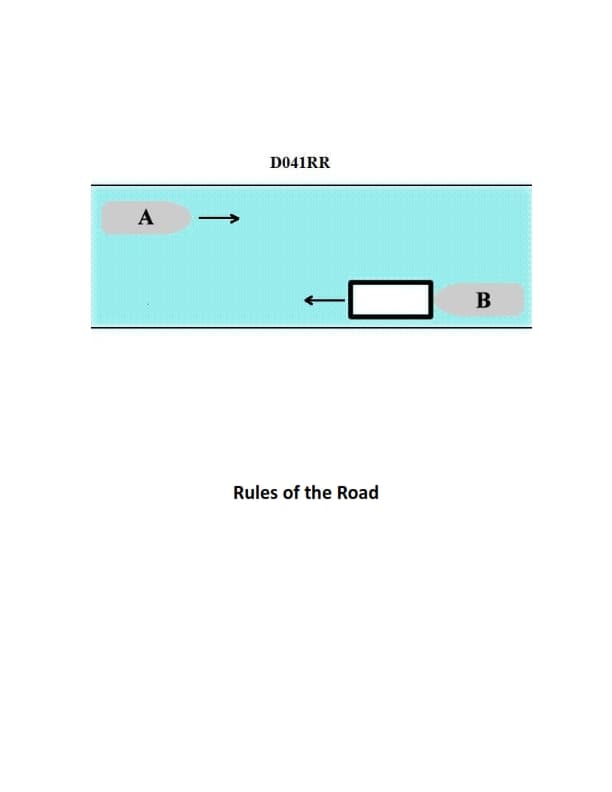
UFV01INLAND ONLY Vessels "A" and "B" are meeting on a river as shown in illustration D041RR below and will pass 1/4 mile apart. Which is one of the lights on vessel "B" that you will see if you are on vessel "A"?
AI Explanation
The Correct Answer is C
### Explanation for why option C ("special flashing light") is correct:
The **special flashing light** is a unique requirement under the Inland Rules of the Road (33 CFR 83.23(d)). This light is a yellow light flashing at 50 to 70 flashes per minute and is positioned forward on the vessel.
It is specifically mandated for a power-driven vessel (like Vessel B) when engaged in **pushing ahead or towing alongside** where the length of the tow is less than 200 meters (about 656 feet) and the vessel is operating on the Western Rivers or specific designated waters.
Since Vessel B is engaged in a common Inland operation (pushing barges), the special flashing light would be displayed toward the bow. In a "meeting" situation on a river, Vessel A would see this light clearly, as it is designed to warn oncoming traffic of the close-coupled unit.
### Explanation for why the other options are incorrect:
* **A) yellow towing light:** The yellow towing light is required on all towing vessels. However, it is a steady light displayed **aft** (near the stern) of the vessel, typically above or below the stern light. In a standard "meeting" situation where Vessel A is approaching Vessel B from ahead, Vessel A would not be able to see the stern light or the yellow towing light.
* **B) red sidelight:** The red sidelight (port side) is a standard navigation light. Whether Vessel A sees the red sidelight (B’s port side) or the green sidelight (B’s starboard side) depends entirely on the precise passing arrangement (one-whistle, port-to-port, or two-whistle, starboard-to-starboard). Since the passing arrangement is not specified, this light is not a guaranteed observation in a meeting scenario, whereas the Special Flashing Light (if B is towing/pushing) is positioned forward for oncoming traffic.
* **D) All of the above:** Since options A and B are not necessarily visible or guaranteed in a head-on meeting situation, this option is incorrect.