Question 113Electricity/Electronics - Assistant Engineer70% to pass
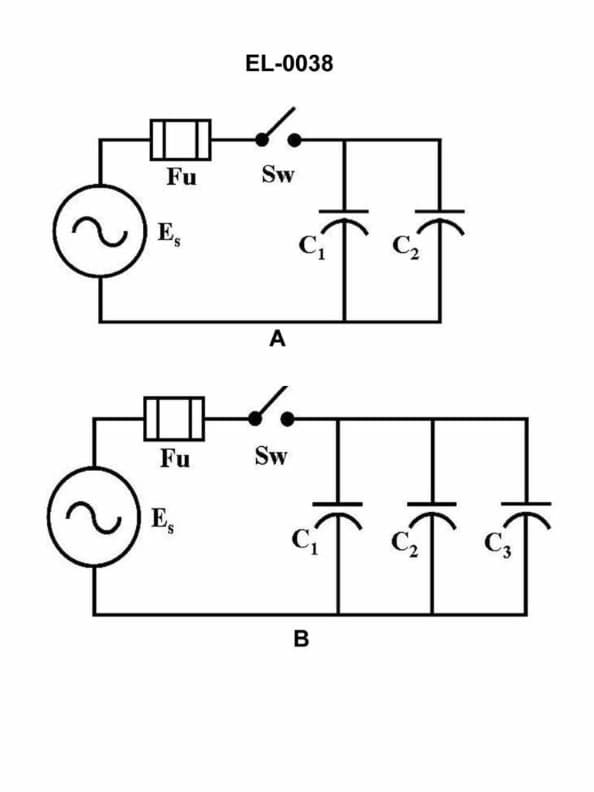
What would be the capacitive reactance of the circuit shown in figure "A" of the illustration if the capacitance of C1 was 100 microfarads, the capacitance of C2 was 200 microfarads and the frequency of the source was 60 cycles per second (Hz)? Illustration EL-0038
AI Explanation
The correct answer is A) 8.8 ohms.
The capacitive reactance (Xc) of a circuit is calculated using the formula Xc = 1 / (2πfC), where f is the frequency of the source and C is the capacitance. In this case, the frequency is 60 Hz, and the capacitances are 100 microfarads (0.0001 farads) for C1 and 200 microfarads (0.0002 farads) for C2. Plugging these values into the formula, we get Xc1 = 1 / (2π * 60 * 0.0001) = 26.5 ohms for C1, and Xc2 = 1 / (2π * 60 * 0.0002) = 13.3 ohms for C2. The total capacitive reactance of the circuit is the parallel combination of these two reactances, which is 8.8 ohms.
Related Questions
#111 Two 100 watt light bulbs rated at 100 volts are connected in parallel across a 100 volt power supply. What will be the total power consumed by the two bulbs? #112 What is the current flowing through R3 in figure "B" of the illustrated circuit when the switch is closed if the battery voltage is 12 VDC and resistance of R1 is 2 ohms, R2 is 3 ohms, and R3 is 6 ohms, respectively? Illustration EL-0019 #114 What would be the total capacitance of the circuit illustrated in figure "A" if the value of capacitor C1 was 100 microfarads and capacitor C2 was 200 microfarads? Illustration EL-0038 #115 As shown in figure "A" of the illustration, with the switch closed what statement is true if 'R1' and 'R2' have unequal resistance values? Illustration EL-0019 #116 Four lamps are connected in parallel in a single circuit. If one of the lamps burns out, what will happen to the other lamps?