Question 505Electricity/Electronics - Assistant Engineer70% to pass
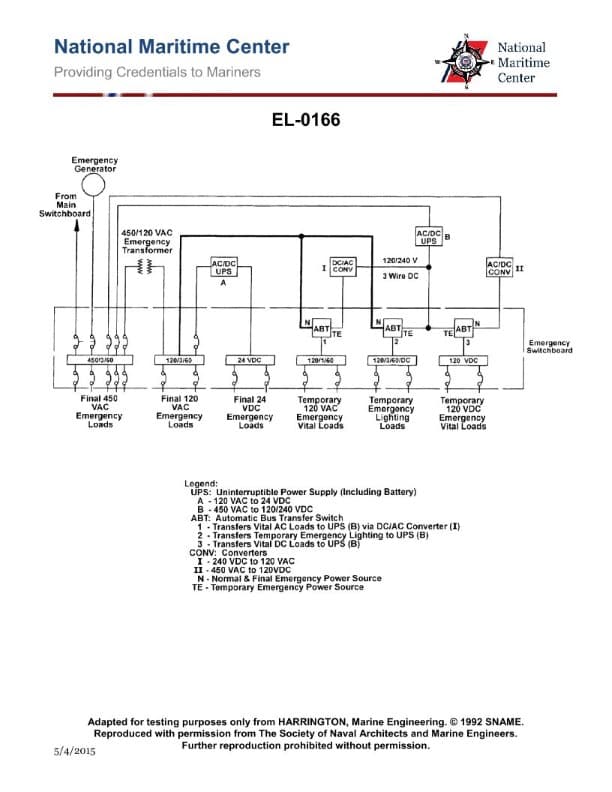
As shown in the illustrated one-line diagram of a two-tiered emergency power system for a passenger ship, what statement is true? Illustration EL-0166
AI Explanation
The correct answer is A.
On a loss of normal ship's power, the temporary emergency loads power source is the battery (from AC/DC UPS "B"), whereas the final emergency loads power source is the emergency generator. This is in accordance with maritime regulations that require emergency power systems to have a temporary source (such as batteries) to immediately supply critical loads, followed by a final source (such as an emergency generator) to sustain power for a longer duration.
The other options are incorrect because they do not accurately describe the power flow and sources as depicted in the one-line diagram. For example, option B incorrectly states that the final emergency loads power source is the battery, when it should be the emergency generator.
Related Questions
#503 When a self-excited alternator's field has lost its residual magnetism due to a prolonged idle period, it will fail to produce a voltage. Flashing the field is the procedure used to restore the residual magnetism. Using a 12 volt storage battery, how is this performed? #504 Under unusual circumstances, it may be required to operate a ship's service generator above its rated kVA. What supplemental casualty control action will be required? #506 Upon loss of field excitation of a generator operating in parallel with others, what must be done? #507 If it becomes absolutely necessary to run an alternator at lower than 5% below its rated frequency, in terms of output voltage, what must be done? #508 In the illustrated one-line diagram, if the ship's service generator on line fails, what statement is true concerning the operation of the emergency diesel-generator? Illustration EL-0014