Question 158Electricity/Electronics - 1st Asst/Chief70% to pass
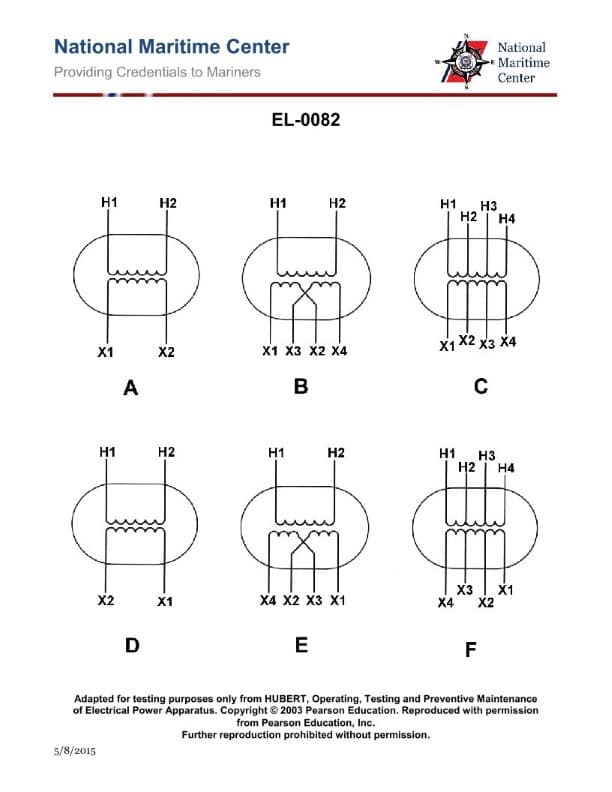
The turn’s ratio of the step-down transformer with dual voltage secondary shown in figure "B" of the illustration is two to one (total). If 220 volts were applied to terminals 'H1' and 'H2', what would be measured across 'X3' and 'X4'? Illustration EL-0082
AI Explanation
The correct answer is A) 55 volts.
In a step-down transformer with a 2:1 turns ratio, the secondary voltage will be half the primary voltage. Since the primary voltage is 220 volts, the secondary voltage across terminals X3 and X4 will be 220 volts / 2 = 110 volts.
The other options are incorrect because:
B) 110 volts is the voltage across the entire secondary winding, not just terminals X3 and X4.
C) 440 volts and D) 880 volts are incorrect as they do not match the 2:1 turns ratio of the transformer.
Related Questions
#156 A carbon resistor has a resistance of 50 ohms, and a tolerance of 5 percent. What would be the respective colors indicated for bands 1, 2, 3 and 4 for this resistor as shown in figure "A" of the illustration? Illustration EL-0103 #157 A 440/110 V single phase transformer supplies a load of 5 kW at 0.8 power factor load. What will be its primary current? #159 What is the maximum current allowed to be drawn from the secondary of a 2 kVA step-down transformer with a turn’s ratio of four to one if connected across a 440 volt line? #160 A 440/110 V single phase transformer supplies a load of 5 kW at 0.8 power factor load. What will be its secondary current ignoring transformer power losses? #161 Refer to the simplified schematic of the Ward-Leonard drive system shown in the illustration. The DC winch exhibits normal speed control from minimum to base speed, but the speed cannot be elevated above base speed. What condition would account for this? Illustration EL-0153