Question 391Electricity/Electronics - QMED70% to pass
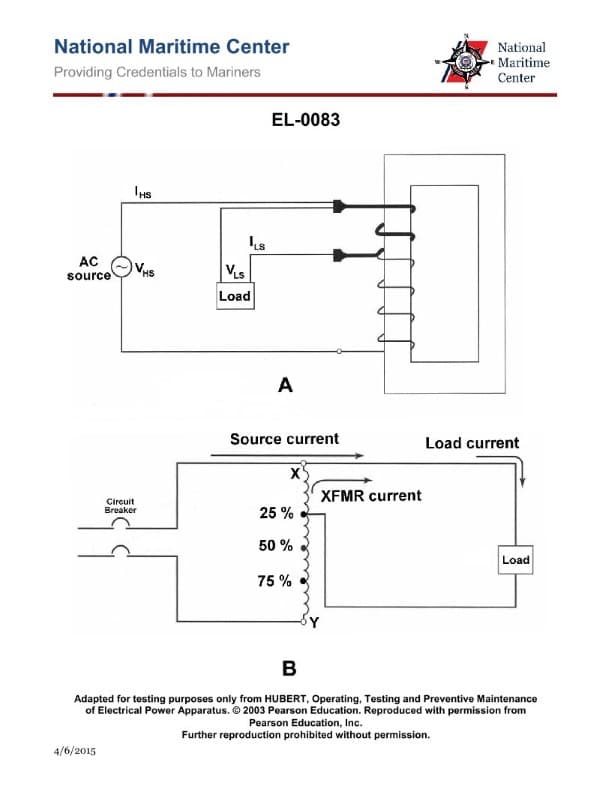
What would be the source current and transformer current as shown in figure "B" of the illustration, with the secondary tap connected as shown, if the supply voltage at the branch circuit breaker is 440 VAC and the unity power factor load current draw is 50 amps? Illustration EL-0083
AI Explanation
The correct answer is A) Source current is 12.5 amps, transformer current is 37.5 amps.
This is correct because in a transformer with a unity power factor load, the source current will be the load current divided by the turns ratio of the transformer. With a 440 VAC supply and a 50 amp load, the source current is 50 amps divided by the turns ratio, which is 4:1. This results in a source current of 12.5 amps.
The transformer current will be the load current, which is 50 amps, multiplied by the turns ratio, which is 4:1. This results in a transformer current of 37.5 amps.
The other options are incorrect because they do not correctly apply the turns ratio to calculate the source and transformer currents.
Related Questions
#389 If the illustrated device in figure "B" has a step-up ratio of 10 to 1 what voltage would be measured at the secondary shortly after the primary of the device is connected to 110 volts DC with a current of 12 amps? Illustration EL-0055 #390 An open primary coil in a simple potential transformer will be indicated by which of the listed conditions? #392 The torque-speed and current-speed curves for a three-phase induction motor with a squirrel cage rotor are shown in figures "A" and "B" of the illustration. Which of the following statements is true concerning the depicted curves? Illustration EL-0056 #393 In general, what type of starter would be used to connect polyphase induction motors to full line voltage at the instant of start-up? #394 Autotransformer starters, sometimes called starting compensators, are sometimes used with larger polyphase induction motors. What function do they perform?