Question 520Electricity/Electronics - QMED70% to pass
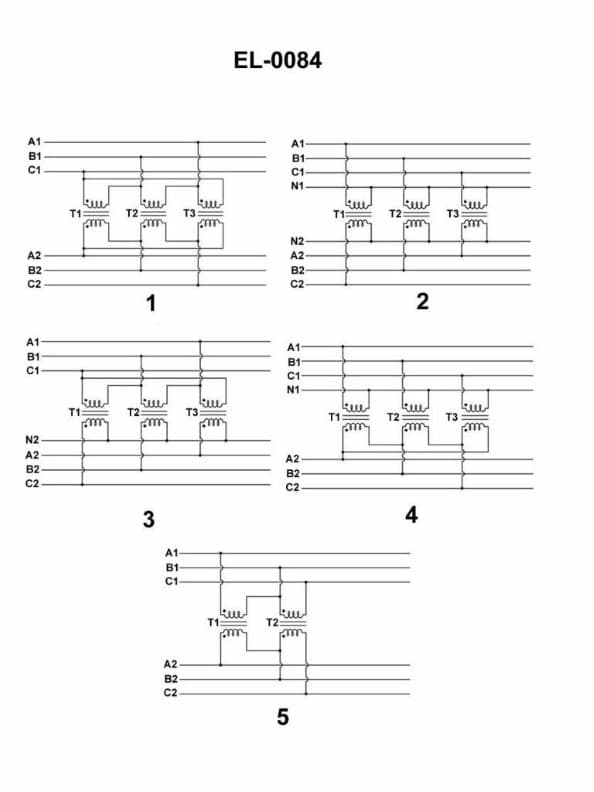
In figure "2" of the diagram shown in the illustration, the three phase power transformer has a step-down turns ratio of four to one. If a three-phase 440 volt supply is connected to terminals 'A1-B1-C1’, what voltage should develop across terminals 'A2-B2-C2'? Illustration EL-0084
AI Explanation
The correct answer is B) 110 volts.
The key information provided is that the three-phase power transformer in the diagram has a step-down turns ratio of 4:1. This means that for every 4 turns on the primary winding (connected to the 440 volt supply), there is 1 turn on the secondary winding.
With a 4:1 turns ratio, the output voltage on the secondary winding (terminals A2-B2-C2) will be 1/4 of the input voltage of 440 volts, which equals 110 volts. This is the correct answer.
The other options are incorrect because they do not correctly apply the 4:1 step-down turns ratio to calculate the expected secondary voltage.
Related Questions
#518 With what device is the RPM of an AC generator indirectly measured on a switchboard when operating singly (no other generator connected to the bus)? #519 The turns ratio of the step-down transformer with dual voltage secondary as shown in figure "B" of the illustration is two to one (total). If 440 volts were applied to terminals 'H1' and 'H2', what would be measured across 'X1-X3' and 'X2-X4' assuming that the secondary windings are connected in parallel? Illustration EL-0082 #521 What is the maximum allowable primary current of a 2 kVA step-down transformer with a four to one turns ratio if the primary is connected across a 440 volt line? #522 A load is connected across the secondary of the step-up transformer shown in figure "B" of the illustration and the current drawn by the load is 10 amps. If the turns ratio is 1 to 10 and the input voltage is 110 VAC, what will be the current drawn by the primary? Illustration EL-0055 #523 As load is added to a DC shunt motor, how will the motor respond?