Question 522Electricity/Electronics - QMED70% to pass
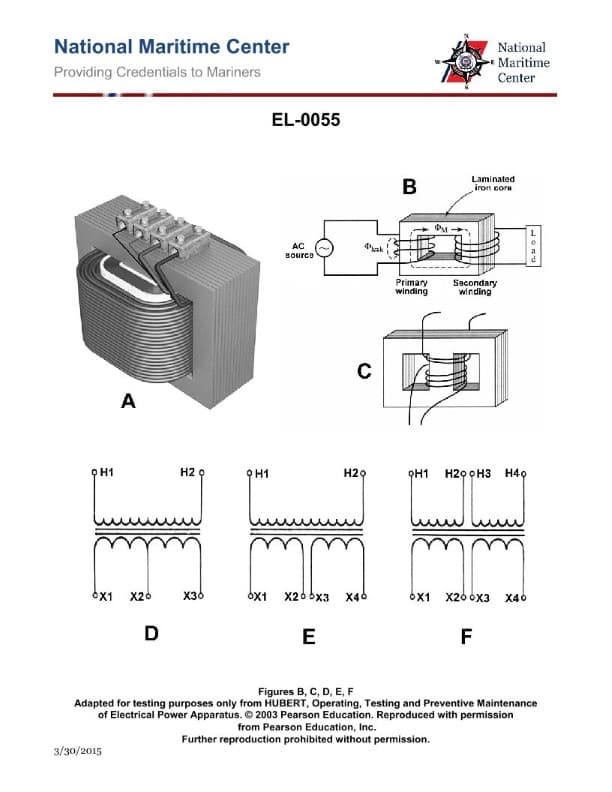
A load is connected across the secondary of the step-up transformer shown in figure "B" of the illustration and the current drawn by the load is 10 amps. If the turns ratio is 1 to 10 and the input voltage is 110 VAC, what will be the current drawn by the primary? Illustration EL-0055
AI Explanation
The correct answer is C) 100 amps.
In a step-up transformer, the turns ratio is inversely proportional to the current ratio. Since the turns ratio is 1 to 10, the current in the primary will be 10 times less than the current in the secondary. With a secondary current of 10 amps, the primary current will be 10 times less, which is 100 amps.
The other options are incorrect because:
A) 1 amp is too low, as the primary current should be 100 times the secondary current.
B) 10 amps is the secondary current, not the primary current.
D) 1000 amps is too high, as the primary current should be 10 times the secondary current.
Related Questions
#520 In figure "2" of the diagram shown in the illustration, the three phase power transformer has a step-down turns ratio of four to one. If a three-phase 440 volt supply is connected to terminals 'A1-B1-C1’, what voltage should develop across terminals 'A2-B2-C2'? Illustration EL-0084 #521 What is the maximum allowable primary current of a 2 kVA step-down transformer with a four to one turns ratio if the primary is connected across a 440 volt line? #523 As load is added to a DC shunt motor, how will the motor respond? #524 In an ungrounded distribution system, as compared to a normal indication, what is the indication on a switchboard of a current carrying conductor making an accidental electrical contact with a wiring metal conduit? #525 A switchboard ammeter indicates a reading slightly above 'zero' when the leads are disconnected. What is this caused by?