Question 80Electricity/Electronics - QMED70% to pass
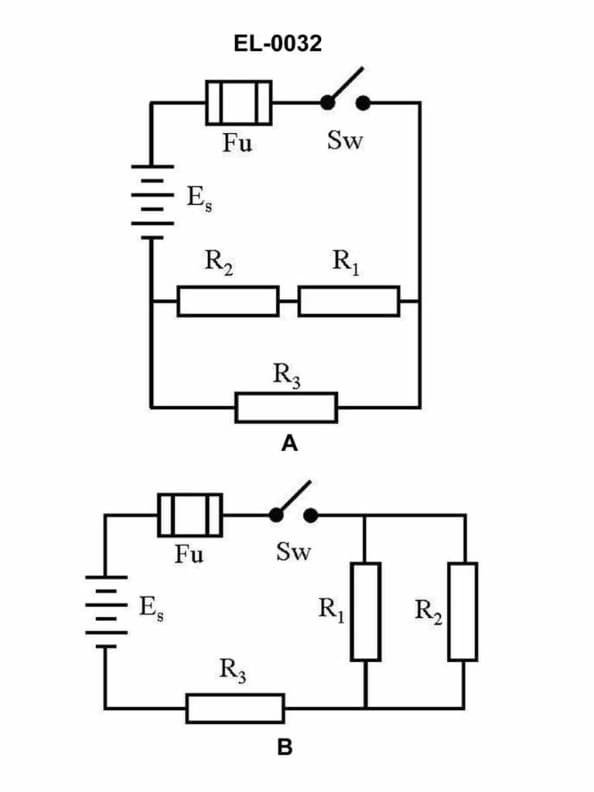
What would be the total current flowing in the circuit shown in figure "B" of the illustration if the source is 30 volts, the resistance of R1 is 10 ohms, R2 is 10 ohms and R3 is 10 ohms, respectively? Illustration EL-0032
AI Explanation
The correct answer is B) 2 amps.
To calculate the total current flowing in the circuit, we can use the formula for total resistance in a parallel circuit: 1/Rtotal = 1/R1 + 1/R2 + 1/R3. Given that R1, R2, and R3 are all 10 ohms, the total resistance is 10/3 ohms. Applying Ohm's law, with a source voltage of 30 volts, the total current in the circuit is 30 volts / (10/3 ohms) = 2 amps.
The other options are incorrect because:
A) 1 amp is too low, as the calculation shows the total current is 2 amps.
C) 5 amps is too high, as the total resistance of 10/3 ohms would not allow for 5 amps of current.
D) 15 amps is also too high and not possible given the source voltage and resistance values provided.
Related Questions
#78 In a simple DC circuit, the resistance is held constant while the applied voltage is halved. What will be the effect on the current flow as compared to the original current? #79 What will be the resulting current when a voltage of 442.7 VDC is applied to a resistance of 1.25 ohms in figure "A" of the illustrated circuit when the switch is closed? Illustration EL-0018 #81 If the voltage supplied to the lighting circuit is 110 volts, how much current is drawn by a 100 watt light bulb? #82 What will be the resulting current when a voltage of 115 VDC is applied to a resistance of 12 ohms in figure "A" of the illustrated circuit with the switch closed? Illustration EL-0018 #83 What will be the resulting current when a voltage of 110 VDC is applied to a resistance of 32 ohms in figure "A" of the illustrated circuit when the switch is closed? Illustration EL-0018