Question 253Rules of the Road90% to pass
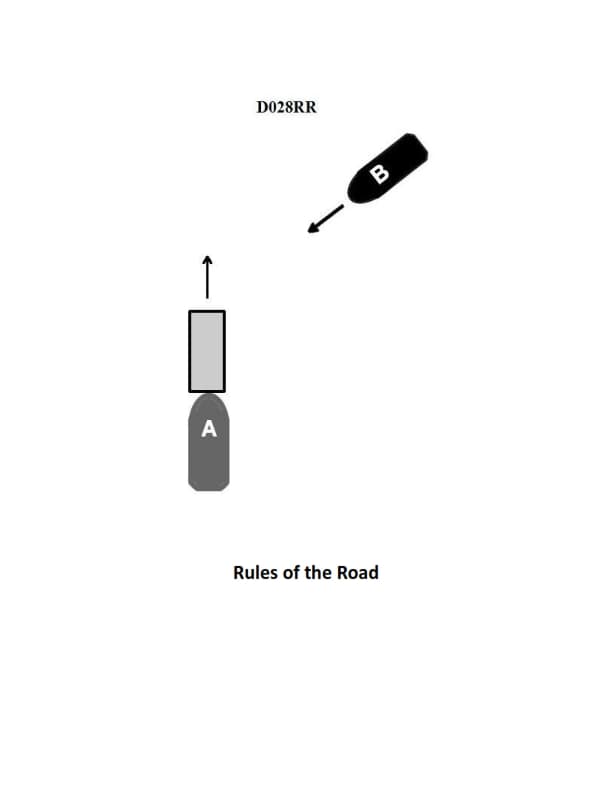
BOTH INTERNATIONAL & INLAND Vessel "A" is underway and pushing ahead when vessel "B" is sighted off the starboard bow as shown in illustration D028RR below. Which vessel is the stand-on vessel?
AI Explanation
The correct answer is A) Vessel "B" is the stand-on vessel because it is to starboard of vessel "A".
According to the International Regulations for Preventing Collisions at Sea (COLREGS), Rule 15, which governs crossing situations, the vessel that has the other on its starboard side (in this case, vessel "B") is the stand-on vessel and must maintain its course and speed. Vessel "A", being the give-way vessel, must take early and substantial action to avoid a collision.
The other answer choices are incorrect because: B) Neither vessel is the stand-on vessel, which contradicts the COLREGS; C) Vessel "A" is not the stand-on vessel just because it is to port; and D) Vessel "A" being the pushing ahead vessel does not make it the stand-on vessel in a crossing situation.
Related Questions
#251 BOTH INTERNATIONAL & INLAND You are aboard the give-way vessel in a crossing situation. Which action should be avoided?#252 BOTH INTERNATIONAL & INLAND In a crossing situation, the vessel which has the other on her own starboard side shall take which action? #254 BOTH INTERNATIONAL & INLAND You are underway in reduced visibility. You hear the fog signal of another vessel about 20° on your starboard bow. Risk of collision may exist. Which action should you take? #255 BOTH INTERNATIONAL & INLAND In illustration D005RR below, vessel "A", which is pushing ahead, and vessel "B" are crossing. Which is the stand-on vessel? #256 BOTH INTERNATIONAL & INLAND Your power-driven vessel is stopped and making no way, but is not in any way disabled. Another vessel is approaching you on your starboard beam. Which statement is TRUE?