Question 255Rules of the Road90% to pass
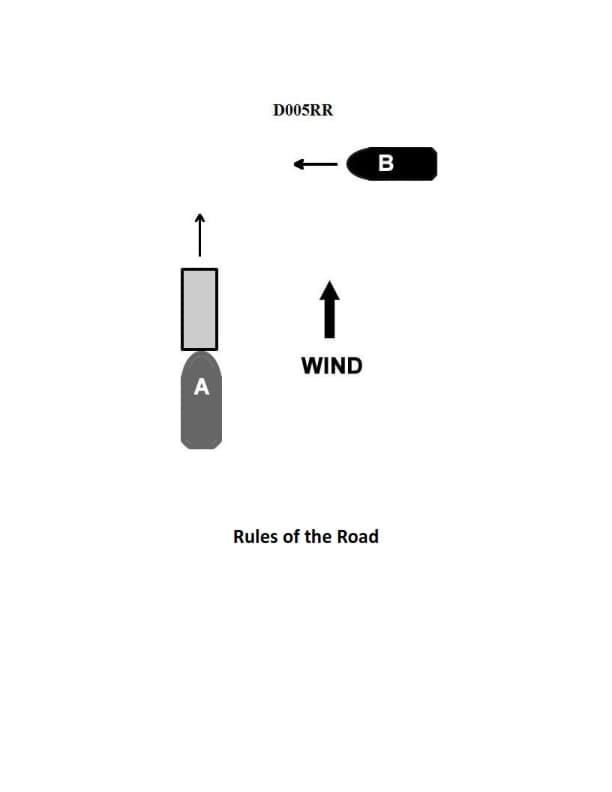
BOTH INTERNATIONAL & INLAND In illustration D005RR below, vessel "A", which is pushing ahead, and vessel "B" are crossing. Which is the stand-on vessel?
AI Explanation
The correct answer is B) Vessel "B" is the stand-on vessel because she is to starboard of vessel "A".
According to the International and Inland Navigation Rules, when two power-driven vessels are crossing, the vessel that has the other on her own starboard side is the stand-on vessel and must maintain her course and speed. In this case, vessel "B" is to the starboard side of vessel "A", so vessel "B" is the stand-on vessel and must hold her course and speed.
The other answer choices are incorrect because: A) Vessel "A" is the give-way vessel, not the stand-on vessel; C) One of the vessels must be the stand-on vessel according to the rules; and D) The relative positions of the vessels, not which one is to port, determine the stand-on vessel.
Related Questions
#253 BOTH INTERNATIONAL & INLAND Vessel "A" is underway and pushing ahead when vessel "B" is sighted off the starboard bow as shown in illustration D028RR below. Which vessel is the stand-on vessel? #254 BOTH INTERNATIONAL & INLAND You are underway in reduced visibility. You hear the fog signal of another vessel about 20° on your starboard bow. Risk of collision may exist. Which action should you take? #256 BOTH INTERNATIONAL & INLAND Your power-driven vessel is stopped and making no way, but is not in any way disabled. Another vessel is approaching you on your starboard beam. Which statement is TRUE? #257 BOTH INTERNATIONAL & INLAND Which statement is TRUE, according to the Rules? #258 BOTH INTERNATIONAL & INLAND Which is TRUE of a stand-on vessel?