Question 271Rules of the Road90% to pass
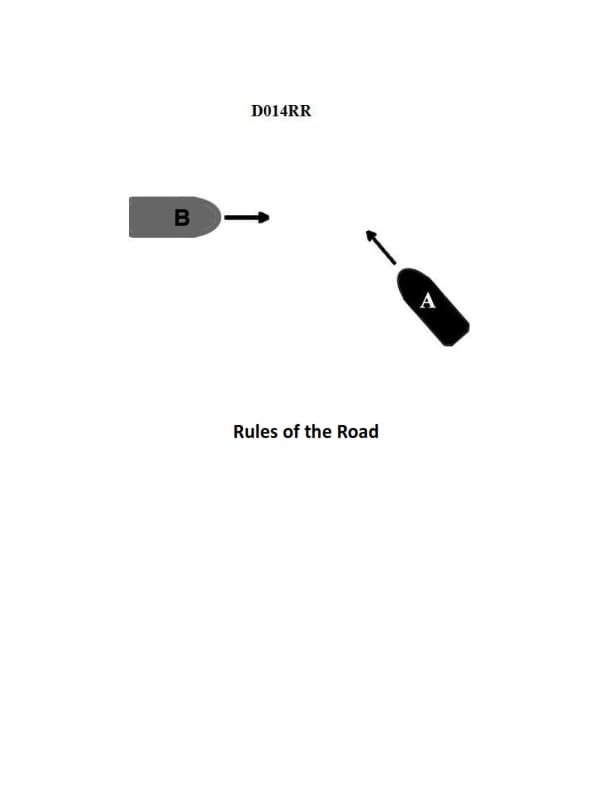
BOTH INTERNATIONAL & INLAND Vessel "A", a power-driven vessel underway, sights vessel "B" which is a vessel underway and fishing as shown in illustration D014RR below. Which statement is TRUE?
AI Explanation
The correct answer is B) Vessel "A" must keep out of the way of vessel "B" because "B" is fishing.
The reasoning is based on the International Regulations for Preventing Collisions at Sea (COLREGS), which state that a vessel engaged in fishing has the right-of-way over a power-driven vessel underway. This is covered in Rule 18 of the COLREGS, which outlines the responsibilities between different types of vessels.
The other options are incorrect because: A) the fact that "B" is to port is irrelevant, as the fishing vessel has the right-of-way; C) both vessels do not have to keep clear of each other, as the power-driven vessel "A" must give way to the fishing vessel "B"; and D) "B" does not have to keep out of the way of "A" because "B" is the vessel engaged in fishing.
Related Questions
#269 BOTH INTERNATIONAL & INLAND In a crossing situation on open waters, which does a sailing vessel NOT have to "keep out of the way of"?#270 BOTH INTERNATIONAL & INLAND Which statement is TRUE concerning seaplanes on the water? #272 BOTH INTERNATIONAL & INLAND Vessels I and II are underway as shown in illustration D033RR below. Vessel I is a sailing vessel with the wind dead aft. Vessel II is a powerdriven vessel trawling. Which statement is TRUE? #273 BOTH INTERNATIONAL & INLAND You are aboard vessel "A" , a power-driven vessel, on open waters and vessel "B", a sailing vessel, is sighted off your port bow as shown in illustration D027RR below. Which vessel is the stand-on vessel? #274 BOTH INTERNATIONAL & INLAND A fishing vessel is approaching a vessel not under command. Which statement is TRUE?