Question 272Rules of the Road90% to pass
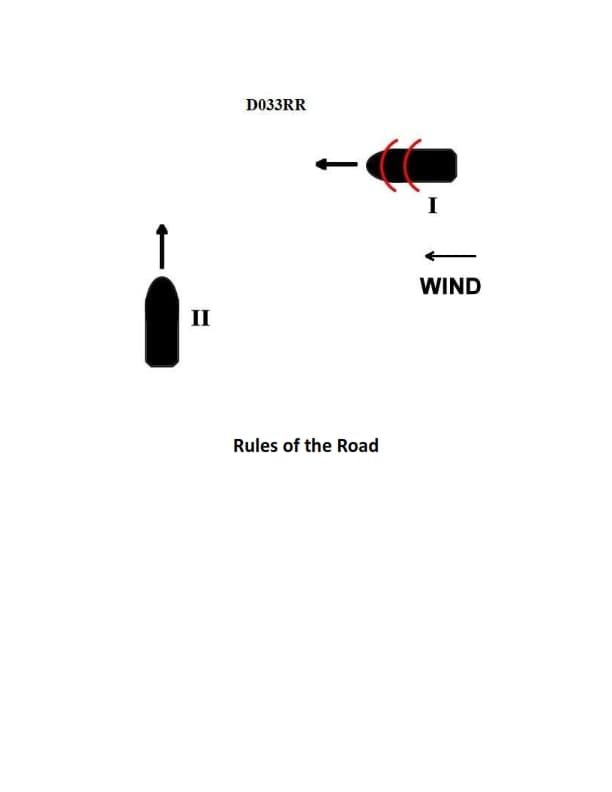
BOTH INTERNATIONAL & INLAND Vessels I and II are underway as shown in illustration D033RR below. Vessel I is a sailing vessel with the wind dead aft. Vessel II is a powerdriven vessel trawling. Which statement is TRUE?
AI Explanation
The correct answer is C) Vessel I is to keep clear because the other vessel is fishing.
This is based on the International Regulations for Preventing Collisions at Sea (COLREGS), Rule 3(d) which states that a "power-driven vessel engaged in fishing shall, so far as possible, keep out of the way of a vessel not under command or a vessel restricted in her ability to maneuver." Since Vessel II is a power-driven vessel engaged in fishing (trawling), it has the right-of-way, and Vessel I, the sailing vessel, is required to keep clear.
The other answer choices are incorrect because: A) Vessel II, as the power-driven fishing vessel, does not have to keep clear; B) Both vessels do not have to take action, as the sailing vessel is required to keep clear; and D) Vessel II, as the power-driven fishing vessel, does not have to keep clear.
Related Questions
#270 BOTH INTERNATIONAL & INLAND Which statement is TRUE concerning seaplanes on the water? #271 BOTH INTERNATIONAL & INLAND Vessel "A", a power-driven vessel underway, sights vessel "B" which is a vessel underway and fishing as shown in illustration D014RR below. Which statement is TRUE? #273 BOTH INTERNATIONAL & INLAND You are aboard vessel "A" , a power-driven vessel, on open waters and vessel "B", a sailing vessel, is sighted off your port bow as shown in illustration D027RR below. Which vessel is the stand-on vessel? #274 BOTH INTERNATIONAL & INLAND A fishing vessel is approaching a vessel not under command. Which statement is TRUE? #275 BOTH INTERNATIONAL & INLAND You are aboard vessel "A" which is towing on open waters when vessel "B", a sailing vessel, is sighted off your port bow as shown in illustration D020RR below. Which vessel is the stand-on?