Question 883Rules of the Road90% to pass
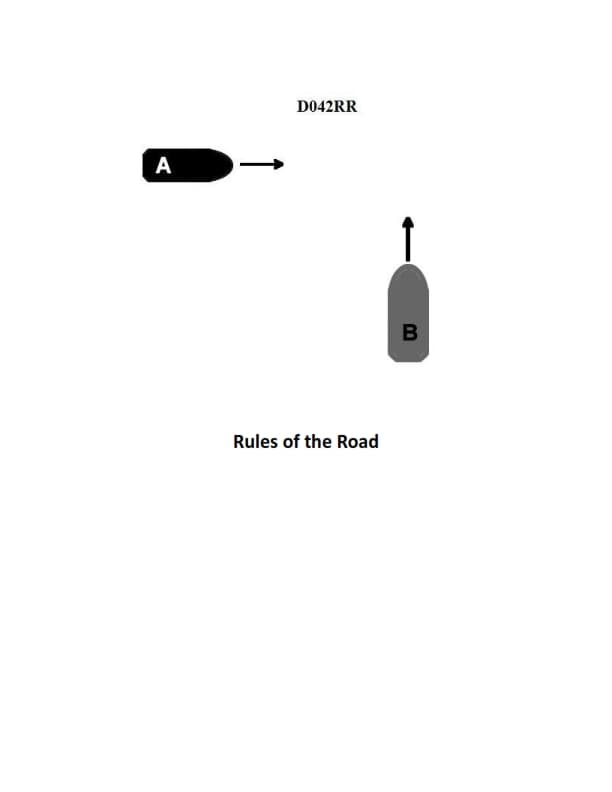
BOTH INTERNATIONAL & INLAND Two power-driven vessels are crossing as shown in illustration D042RR below. Vessel "A" sounds two short blasts on the whistle. You are on vessel "B" and are in doubt that sufficient action is being taken by vessel "A" to avoid collision. What action should you take?
AI Explanation
The correct answer is B) Sound five or more short and rapid blasts.
The reasoning behind this is that when the give-way vessel (vessel "A") is not taking appropriate action to avoid a collision, the stand-on vessel (vessel "B") should sound the danger signal of five or more short and rapid blasts on the whistle. This is in accordance with the International Regulations for Preventing Collisions at Sea (COLREGS), which govern navigational rules for vessels at sea.
The other options are incorrect because: A) Maintaining course and speed would not be the appropriate action when the give-way vessel is not maneuvering to avoid a collision. C) Altering course to the left and increasing speed could potentially put the vessels on a collision course. D) There is a specific action required by the COLREGS in this situation, so "none of the above" is not the correct answer.
Related Questions
#881 BOTH INTERNATIONAL & INLAND A vessel 25 meters in length must have which sound signaling appliance onboard? #882 BOTH INTERNATIONAL & INLAND Which vessel must have a gong, or other equipment which will make the sound of a gong? #884 BOTH INTERNATIONAL & INLAND Which vessel may sound the danger signal? #885 BOTH INTERNATIONAL & INLAND You are on vessel "A" as shown in illustration D032RR below, and hear vessel "B" sound a signal indicating her intention to overtake you. You feel it is not safe for vessel "B" to overtake you at the present time. What action should you take? #886 BOTH INTERNATIONAL & INLAND You are approaching a bend in a channel. You cannot see around the bend because of the height of the bank. Which action are you required to take in accordance with the Rules?