Question 885Rules of the Road90% to pass
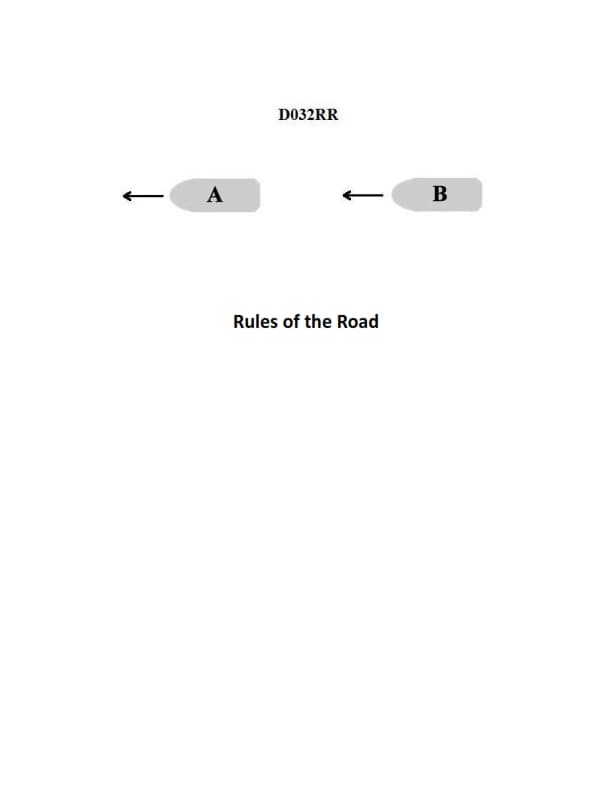
BOTH INTERNATIONAL & INLAND You are on vessel "A" as shown in illustration D032RR below, and hear vessel "B" sound a signal indicating her intention to overtake you. You feel it is not safe for vessel "B" to overtake you at the present time. What action should you take?
AI Explanation
The correct answer is C) Sound five or more short rapid blasts.
This is the correct action because according to the International Regulations for Preventing Collisions at Sea (COLREGS), when a vessel is overtaking another vessel, the overtaking vessel must indicate its intention to do so by sounding the appropriate whistle signal. If the vessel being overtaken (vessel A) feels it is not safe for the overtaking vessel (vessel B) to proceed, vessel A should sound five or more short rapid blasts on the whistle to indicate that it is unsafe to overtake at the present time.
The other options are incorrect because option A would be the wrong signal, option B would be ignoring the overtaking vessel's signal, and option D would be the wrong number of blasts.
Related Questions
#883 BOTH INTERNATIONAL & INLAND Two power-driven vessels are crossing as shown in illustration D042RR below. Vessel "A" sounds two short blasts on the whistle. You are on vessel "B" and are in doubt that sufficient action is being taken by vessel "A" to avoid collision. What action should you take? #884 BOTH INTERNATIONAL & INLAND Which vessel may sound the danger signal? #886 BOTH INTERNATIONAL & INLAND You are approaching a bend in a channel. You cannot see around the bend because of the height of the bank. Which action are you required to take in accordance with the Rules? #887 BOTH INTERNATIONAL & INLAND You are on a 15-meter vessel "A" in a narrow channel as shown in illustration D032RR below. Vessel "B", a large tanker which can safely navigate only within the channel, sounds five short and rapid blasts. What action should you take? #888 BOTH INTERNATIONAL & INLAND You are the stand-on vessel in a crossing situation. Which signal should you sound if you think the give-way vessel is NOT taking sufficient action to avoid collision?