Question 10
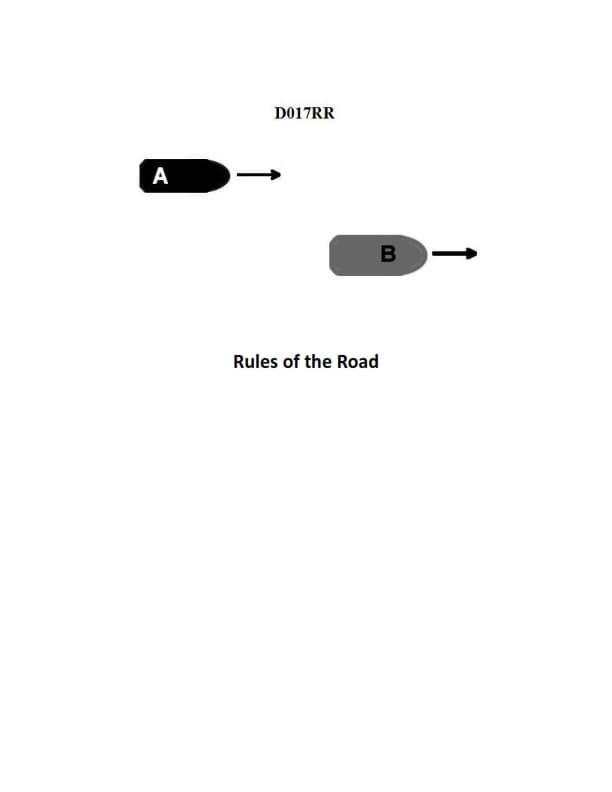
GLI06BOTH INTERNATIONAL & INLAND Vessel "A" is overtaking vessel "B" as shown in illustration D017RR below. Vessel "B" should do which of the following?
AI Explanation
The Correct Answer is B
**Why Option B ("should hold her course and speed") is correct:**
This scenario is governed by the International Regulations for Preventing Collisions at Sea (COLREGs), specifically Rule 13 (Overtaking) and Rule 17 (Action by Stand-on Vessel).
1. **Rule 13 (Overtaking):** Establishes that the vessel being overtaken (Vessel B) is the stand-on vessel, and the vessel overtaking (Vessel A) is the give-way vessel. Vessel A has the duty to keep clear of Vessel B.
2. **Rule 17 (Action by Stand-on Vessel):** Requires the stand-on vessel (Vessel B) to **keep her course and speed**. Vessel B must maintain predictability so that Vessel A can execute a safe passing maneuver and meet its obligation to keep clear.
**Why the other options are incorrect:**
* **A) should slow down until vessel "A" has passed:** This is incorrect because it violates Rule 17. The stand-on vessel must maintain course and speed to allow the give-way vessel to predict her movements and safely pass. Slowing down unexpectedly would create an additional risk of collision.
* **C) may steer various courses and vessel "A" must keep clear:** This is incorrect. While Vessel A must keep clear, Vessel B (the stand-on vessel) is specifically required to maintain a predictable course and speed (Rule 17). Steering "various courses" would make the passing maneuver extremely dangerous and unpredictable.
* **D) should change course to the right:** This is incorrect. Changing course is an action reserved for the give-way vessel (Vessel A). Vessel B, as the stand-on vessel, must hold course and speed unless collision cannot be avoided by the action of the give-way vessel alone (Rule 17(a)(ii)).
Related Questions
#9 Your position is 3 miles due east of Montauk Point Light. What is the course to steer to arrive at LAT
41°00.0'N, LONG 71°30.0'W, if you are turning for 7.8 knots, the current is 130° at 1.2 knots, and a southerly
wind causes 3° of leeway?#9 How does a drift lead indicate that the vessel is dragging anchor?