Question 10
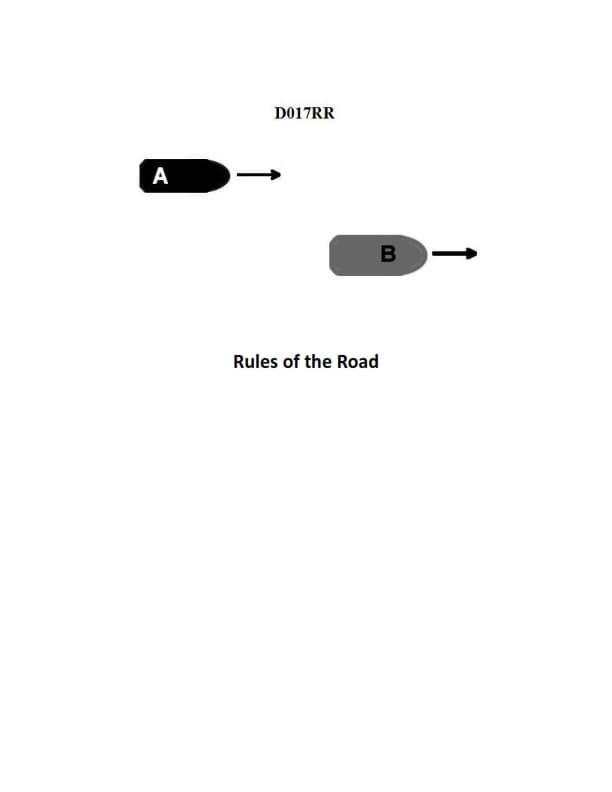
ONC04BOTH INTERNATIONAL & INLAND Vessel "A" is overtaking vessel "B" as shown in illustration D017RR below. Vessel "B" should do which of the following?
AI Explanation
The Correct Answer is B
**Explanation for Option B (Correct Answer):**
This scenario is governed by the International Regulations for Preventing Collisions at Sea (COLREGS) and corresponding Inland Rules. Specifically, Rule 13 (Overtaking) defines the relative duties of the vessels.
1. **Rule 13(a)** states that any vessel coming up with another vessel from a direction more than 22.5 degrees abaft her beam (i.e., when she would only see the sternlight at night) is an overtaking vessel. The overtaking vessel (Vessel "A") is the give-way vessel.
2. **Rule 13(d)** states that the overtaking vessel must keep clear of the vessel being overtaken (Vessel "B") until she is finally past and clear.
3. **Rule 17 (Action by Stand-on Vessel)** dictates the duties of the vessel being kept clear of (Vessel "B"). Rule 17(a)(i) mandates that where one of two vessels is required to keep out of the way, the other shall **keep her course and speed**. Vessel "B" is the stand-on vessel and must maintain her maneuverability predictability for Vessel "A" to execute the passing safely.
Therefore, Vessel "B" should hold her course and speed.
**Explanation for Incorrect Options:**
* **A) should slow down until vessel "A" has passed:** This is incorrect. Changing speed makes Vessel "B" an unpredictable target for the overtaking vessel (A) and violates the stand-on vessel's duty to maintain course and speed (Rule 17(a)(i)).
* **C) may steer various courses and vessel "A" must keep clear:** This is incorrect. While Vessel "A" must keep clear, Vessel "B" (the stand-on vessel) must maintain a predictable course and speed (Rule 17(a)(i)). Vessel "B" is only permitted to take action to avoid collision when collision cannot be avoided by the action of the give-way vessel alone (Rule 17(b)).
* **D) should change course to the right:** This is incorrect. Changing course is an action that violates the stand-on vessel's primary duty (Rule 17(a)(i)). Furthermore, the overtaking vessel (A) is responsible for the necessary maneuvering and passing arrangement, including determining which side to pass on.
Related Questions
#9 A vessel steams 3312 miles on course 282°T from LAT 34°24'S, LONG 18°18'E. What is the latitude and longitude of the point of arrival by Mercator sailing?#9 On 25 March your 0500 ZT DR position is LAT 28°14.0'S, LONG 93°17.0'E. You are on course 291°T at a
speed of 16.0 knots. You observed 3 celestial bodies. Determine the latitude and longitude of your 0550
running fix.