Question 252Electricity/Electronics - Assistant Engineer70% to pass
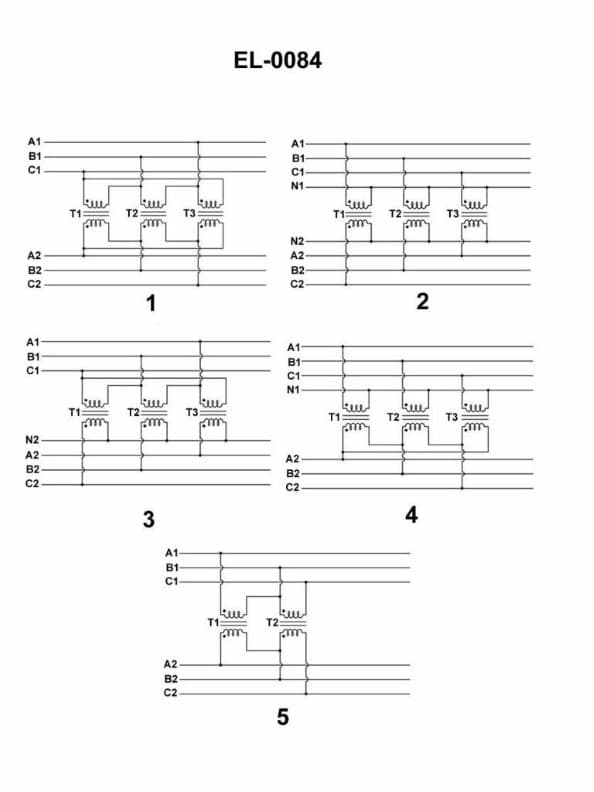
In figure "4" of the diagram in the illustration, the three phase step-down power transformer has a turns ratio of five to one. If a three-phase 4160 volt supply is connected to terminals "A1-B1-B2", what voltage should develop across terminals "A2- B2-C2"? Illustration EL-0084
AI Explanation
The correct answer is C) 480 volts.
The reason is that a three-phase step-down transformer with a turns ratio of 5:1 will transform the 4160 volt three-phase supply down to 480 volts across the secondary terminals A2-B2-C2. This is calculated by taking the primary voltage of 4160 volts and dividing it by the turns ratio of 5, which results in 480 volts on the secondary side.
The other answer choices are incorrect because 240 volts is too low, 415 volts is a common European voltage but not used in the US, and 832 volts is too high for a 5:1 step-down transformer.
Related Questions
#250 In figure "2" of the diagram shown in the illustration, the three phase step-down power transformer has a turns ratio of four to one. If a three-phase 480 volt supply is connected to terminals "A1-B1-C1", what voltage should develop across terminals "A2-B2-C2"? Illustration EL-0084 #251 The turns ratio of the tapped step-down transformer shown in figure "C" of the illustration is four to one and all taps are evenly spaced. If 120 volts were applied to terminals 'H1' and 'H3', what would appear at 'X1' and 'X2'? Illustration EL-0082 #253 If the motor shown in the illustration will not start when the "off-run" switch is placed in the run position, which of the listed components should be checked FIRST? Illustration EL-0017 #254 The motor fails to start on an attempted startup. With the start button depressed, a voltmeter reading between 1 and 5, as in figure "A" shown in the illustration, indicates line voltage available to the control circuit, what should be your next step in the troubleshooting process? Illustration EL-0007 #255 In order to properly set up programmable motor protection, it is necessary to know the locked-rotor current of a motor. Given the chart of code letters for locked-rotor kVA/HP and the necessary instructions shown in the illustration, calculate the estimated locked-rotor current for the motor represented by the illustrated motor nameplate using a mid-range value for the code letter, assuming the motor is to run at 440 VAC. Illustration EL-0175